For the second edition of my series: Not so Famous Founding Fathers, I am profiling Patrick Henry. Patrick Henry is not exactly an unknown Founding Father, as many know the famous line that he uttered. But he did not appear out of thin air to utter that patriotic statement and then disappear. Did you know that Patrick Henry was the first Governor of Virginia after America declared its independence? Did you know that he was against the ratification of the Constitution? Patrick Henry was an impressive individual, as I will describe below.
Patrick Henry was born in Hanover County Virginia in May, 1736. He had some formal education, but entered the workforce at age 15 when he opened a store with his older brother William. After the store went under, and after a failed venture as a planter, he decided to pursue a career as a lawyer, and started to study law. Despite being self taught, he showed energy and intelligence which helped him get admitted to the bar.
Henry built a successful practice arguing cases in Hanover County court, and it was there where he first came to prominence in what was called the “Parsons Cause”. In Colonial Virginia, government officials and members of the church were paid in tobacco with pastors of the Anglican Church, called Parsons, being paid 16,000 pounds of Tobacco which was the equivalent of 320 dollars per year. For years, a pound of tobacco was valued at 2 cents, but due to drought In the late 1750’s the value of tobacco per pound increased. In response, the colonial legislature of Virginia, the House of Burgesses passed a measure which reduced the per pound value of Tobacco back to 2 cents. Several Parsons protested and appealed to the central government in England, which overturned the law. After the law was declared null and void, a Parson named James Maury sued his vestry, or local Anglican Church authority to get his back pay and won. All that was left was to determine how much Maury would be paid. Patrick Henry was appointed to represent the Vestry in the case. He spoke eloquently against the Anglican Church and the power of England and convinced the jury to award Maury 1 cent.
The Parsons’ cause helped launch Henry’s political career, and he won a seat in the House of Burgesses. A few years after his election in 1765, England passed the Stamp Act. In response, Patrick Henry introduced a resolution opposing the Stamp Act, called the “Stamp Act Resolves” which questioned the power of England to directly tax the colonies. In introducing the Resolution, he made a defiant speech, warning that King George III risked suffering a fate similar to what Caesar suffered at the hand of Brutus if he continued to tax the colonies. Opponents of the resolution in the Burgesses were aghast at his resolution and speech, but it passed by a narrow margin. Over the remainder of the 1760’s and into the 1770’s, he served in the Burgesses and grew his law practice, continuing to speak out against the actions of the British.
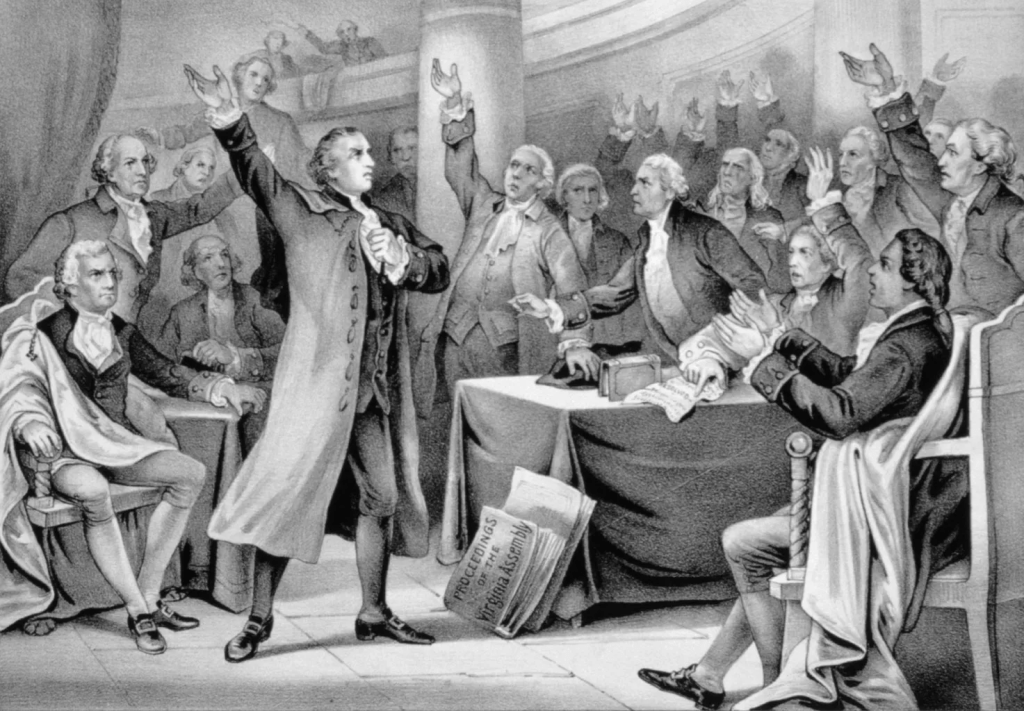
Patrick Henry was appointed as a delegate to the First Continental Congress in 1774. Once there, again stood out for his oratory, where he declared “I am no longer a Virginian or a New Yorker, but an American”. He was an important contributor at the Congress where he served on several committees. He was appointed to the second Continental Congress the following year, but was not much of a factor at that Congress. In between the first and Second Continental Congress, in March 1775, Virginia assembled its own Convention, where the main issue was deciding to respond to the continuing abuses by the British. Some delegates advocated for continuing to resist against the British by peaceful means, but Henry pushed a resolution which favored preparing for a military response. He gave a passionate speech which ended “I know not what course others may take; but as for me, “Give me Liberty, or Give me Death!”, and his resolution passed. Shortly after the start of the Revolutionary War, he was appointed as a military officer, and was given command of a regiment. However, when the regiments in Virginia were incorporated into the Continental Army, his political opponents attempted to sideline him by appointing one of his former subordinates to oversee his regiment. Patrick Henry responded by resigning from service, but he nobly encouraged his troops to resist resigning as well and to serve in the Continental Army.
In the late 1770’s and 1780’s he was again an elected official in Virginia, serving in the House of Delegates and serving two stints as Governor, from 1776-1778, and 1784-1785. In the State Legislature, he was part of the faction that opposed James Madison. While he was not very successful in passing many bills, he successfully amended several bills proposed by Madison. One Madison sponsored bill that passed despite Henry’s opposition was a measure supporting religious freedom and was a precursor to the idea of the separation of church and state which would be enshrined in the Constitution. While Patrick Henry supported Religious Freedom, he opposed the complete separation of church and state.
In 1787, there was a consensus that the Articles of Confederation were ineffective in governing the new United States, so a Convention was called in Philadelphia to draft the Constitution. After the Constitution was complete, he received a copy and gave a vague statement expressing his wariness. This alarmed his old rival in the Delegates, James Madison, one of the primary architects of the Constitution, who proceeded to call him the “most dangerous” opponent of it in Virginia. At the Virginia Convention to ratify the Constitution, Patrick Henry was a staunch opponent of the document. Speaking with usual passionate oratory, he railed against the strengthening of the Federal Government as an assault against the power of the States. He thundered that it was as radical as the revolution that the U.S just undertook against the British. Despite Henry’s opposition, the Constitution was narrowly ratified in Virginia. He stepped down from the House of Delegates in 1790 to dedicate his time on his law practice.
In the 1790’s his political views shifted in favor of the Federalists who he railed against during the ratification of the Constitution. While he did not take a public position on the Alien and Sedition acts, he was alarmed by the Kentucky and Virginia Resolutions written anonymously by Jefferson and Madison. He feared that the Resolutions, which stated that States could overrule unconstitutional acts by the federal government, would lead to chaos and anarchy. At the behest of George Washington, he successfully ran for his old seat in the Virginia House of Delegates in 1799, but died before he took office. The Virginia Gazette in announcing his death said that “As long as our rivers flow, or mountains stand, Virginia . . . will say to rising generations, imitate my Henry”.
Stay tuned for my next person in my series “Not so Famous Founding Fathers.


Leave a Reply